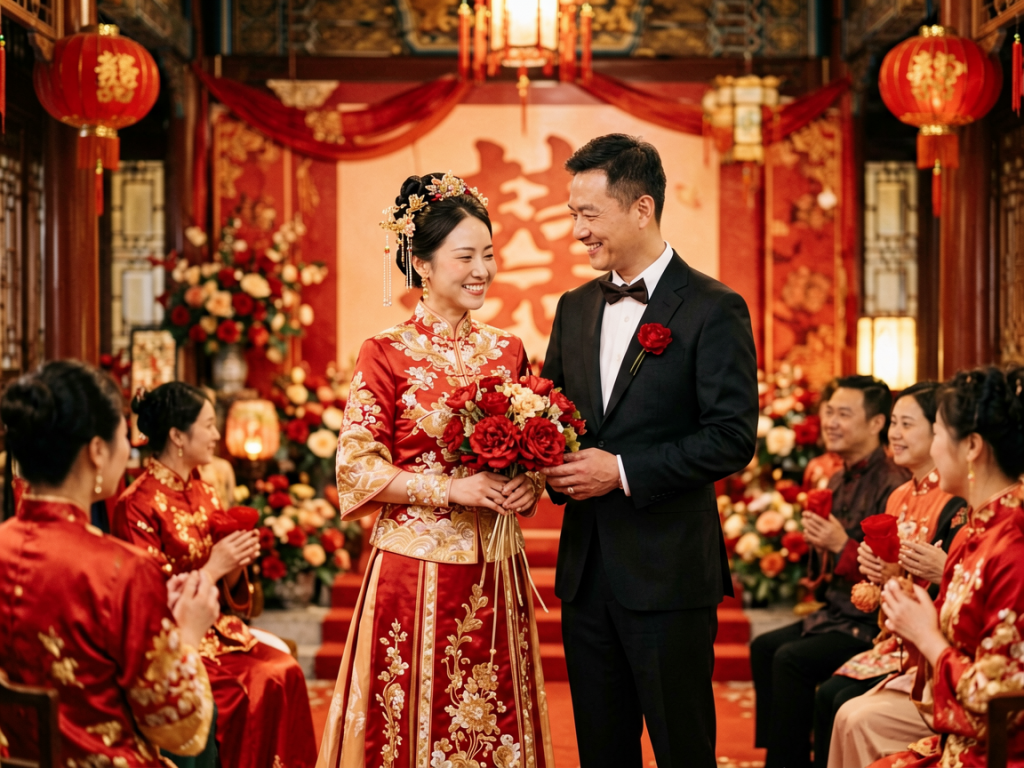
When my friend Li Wei told me he was getting married, I assumed it would be a standard affair. You know the drill. A nice venue, maybe 200 guests, a three-course meal, a toast or two, and then everyone goes home to sleep. I had my suitcase packed for a quick weekend getaway. I was ready to be in and out by midnight on Saturday.
I was wrong. So incredibly wrong.
Li Wei’s wedding wasn’t a single event. It was a marathon. It started with a pre-wedding banquet on Friday, the main ceremony on Saturday, and a farewell brunch on Sunday. By the time I stumbled out of the hotel on Sunday afternoon, I had spent more time with these people than I had in my entire previous year in Shanghai. It was exhausting, loud, chaotic, and honestly, one of the most rewarding experiences of my life.
If you’ve never experienced a traditional Chinese wedding extended over multiple days, you’re missing out on the real heart of Chinese social life. It’s not just about the couple. It’s about families merging, obligations being met, and community bonds being reinforced. Here’s why these three-day affairs exist and what you’re actually signing up for.
The Friday Night Warm-Up
Most Westerners don’t even know this part exists. The wedding officially starts the night before. In some regions, it’s called the “pre-celebration,” but I like to think of it as the dress rehearsal with better champagne. For Li Wei’s wedding, this was held at a nearby hotel that felt like it had been reserved for the groom’s side of the family exclusively.
I arrived at 6 PM, expecting a light appetizer spread. Instead, I walked into a room packed with relatives I’d never met. There were uncles I’d heard stories about, cousins I’d played with as a kid, and distant aunts who immediately started critiquing my choice of tie. It was overwhelming in the best way possible.
The food was heavy. This isn’t a cocktail party. This is a sit-down banquet with dishes that arrive in waves. We had steamed fish, braised pork belly, and some spicy Sichuan dishes that made my mouth burn for hours. The drinking started early. In Chinese culture, you don’t just have a drink; you have rounds. You toast the table, they toast you back, and everyone finishes their glass.
I learned quickly that refusing a toast is a major social faux pas. It’s not about getting drunk. It’s about showing respect. If you’re the guest of honor, or even just a guest, you participate. I ended up drinking so much baijiu that I forgot my own name by 10 PM. But everyone was laughing. The tension of meeting new people evaporated because we were all focused on the same ritual.
This night serves a practical purpose too. It’s a chance for the families to mingle before the big day. The bride’s family and the groom’s family often haven’t sat down together yet. This is where the awkwardness is worked out over plates of dumplings. It’s a low-stakes environment to hash out any last-minute logistics, though mostly it’s just about bonding.
The Saturday Marathon
Now, let’s talk about the main event. If Friday was the warm-up, Saturday was the Olympics. The schedule is brutal. It usually starts with the “door games” early in the morning. This is where the groom and his groomsmen have to prove their love for the bride by solving puzzles, eating weird snacks, and answering embarrassing questions at her door.
I watched Li Wei try to eat a whole raw onion while reciting a poem. He failed twice. The bride’s female friends were laughing hysterically. It’s a bit like a hazing ritual, but with more flowers and less humiliation. The energy is electric. Everyone is filming on their phones. It’s chaotic and fun.
After the door games, there’s the pickup of the bride. Then comes the journey to the venue. In many parts of China, this involves a motorcade of decorated cars. You’ll see them snaking through the city, honking, with “Just Married” signs everywhere. It’s a public display of joy that draws crowds. People stop to watch. Kids run alongside the cars. It’s a spectacle that turns a private moment into a public celebration.
The actual ceremony at the venue is shorter than you’d think. Maybe 45 minutes. The couple walks down the aisle, exchanges rings, and maybe says a few vows. But the real work happens during the reception. This is where the three-day aspect really kicks in. The reception is a long, drawn-out affair with multiple toasts, speeches, and performances.
In traditional settings, you might see the couple serving tea to their elders. This is a huge deal. It’s called “Jingcha.” The couple kneels before their parents and serves them tea. The parents give them red envelopes with money or jewelry. It’s a symbolic transfer of respect and blessing. I was touched by how serious it was. These aren’t just rituals; they’re emotional milestones.
After the ceremony, the banquet begins. And I mean begins. We ate for two hours. Dishes kept coming. Soup, meat, vegetables, desserts. It’s a test of endurance. You can’t just eat lightly. You have to clear your plate to show appreciation. The hosts want everyone to leave full. If you leave hungry, it’s considered bad hosting.
And the drinking? It continues. The couple goes table to table, toasting every single guest. This takes hours. I saw them visiting over 50 tables. They were smiling, but their eyes were tired. It’s a performance of gratitude. Every guest is important. Every face matters.
The Red Envelope Economy
You can’t talk about Chinese weddings without talking about money. Specifically, the red envelopes, or “hongbao.” This is the social currency of the event. Guests bring cash in red envelopes. The amount depends on your relationship with the couple.
As a foreigner, I didn’t know what to expect. I asked a colleague, and he told me to bring 500 yuan. I thought that was steep. But then I realized that this isn’t a gift; it’s an investment. When my turn comes to get married, I’m expected to give back the same amount, plus interest.
It’s a complex web of reciprocity. I’ve seen friends argue over how much to give. Is 200 yuan enough for a colleague? Is 1,000 yuan too much for a distant cousin? There are unspoken rules. Even numbers are lucky. Four is bad. Eight is good. It’s a mathematical puzzle wrapped in red paper.
During the wedding, I watched a friend slip an envelope into the bride’s dress pocket. It was seamless. No one made a scene. It’s a quiet transaction that keeps the social fabric intact. For the couple, it helps pay for the wedding. For the guests, it’s a way of saying, “I support you.”
I’m no expert on the exact economics, but it’s clear that this system works. It redistributes wealth within the community. It ensures that everyone feels involved. And it takes the pressure off buying physical gifts. No one needs a toaster. They need cash to start their life together.
Sunday’s Gentle Farewell
The final day is often the most personal. After the chaos of Saturday, Sunday is about slowing down. For Li Wei’s wedding, this was a casual brunch. No suits. No gowns. Just comfortable clothes and hangover cures.
We met at a local dim sum place. The atmosphere was relaxed. People were talking about the previous day’s events. “Did you see Uncle Wang’s speech?” “How many bottles of wine did you get rid of?” It was a debrief session. We were processing the experience together.
This day is also important for logistics. In many families, this is when the final gifts are exchanged. Or when the couple says goodbye to guests who are leaving town. It’s a chance to have quiet conversations with people you were too busy to talk to on Saturday.
I spent an hour just talking to Li Wei’s mother. On Saturday, she was running around, checking everything. On Sunday, she sat down with a cup of tea and asked me about my life in China. It was a genuine connection that wouldn’t have happened in the noise of the banquet hall.
This slow ending is crucial. It allows the emotions to settle. It turns a loud party into a meaningful memory. It’s the cool-down after a sprint.
Why It Matters
So, why three days? Why not just one big day? The answer is community. Chinese weddings aren’t just about the bride and groom. They’re about the village. It’s about reinforcing the networks that support individuals throughout their lives.
In a fast-paced, modern China, these traditions persist because they work. They slow us down. They force us to sit with our families and friends. They remind us that we are part of something bigger than ourselves.
I was skeptical at first. I thought it was inefficient. I thought it was excessive. But I’m no longer sure. There’s a depth to these celebrations that single-day weddings lack. You don’t just witness a ceremony; you participate in a lifecycle.
It’s messy. It’s loud. It’s expensive. But it’s also incredibly warm. It makes you feel seen. It makes you feel valued. And in a world that often feels disconnected, that’s a rare gift.
If you’re ever invited to a Chinese wedding, don’t skip the pre-party. Don’t try to leave early. Don’t worry about the red envelope amount too much. Just show up. Be ready to drink. Be ready to eat. And be ready to laugh until your sides hurt.
You’ll be tired. You’ll probably have a headache on Sunday. But you’ll also have a story to tell. And that’s worth every minute of it.
Trust me, I learned this the hard way. But I’d do it again in a heartbeat. Because there’s something special about sharing a meal, a toast, and a life change with people who care about you. It’s not just a wedding. It’s a celebration of connection.
And honestly, that’s better than any foreign alternative I’ve experienced. It’s raw. It’s real. It’s Chinese.