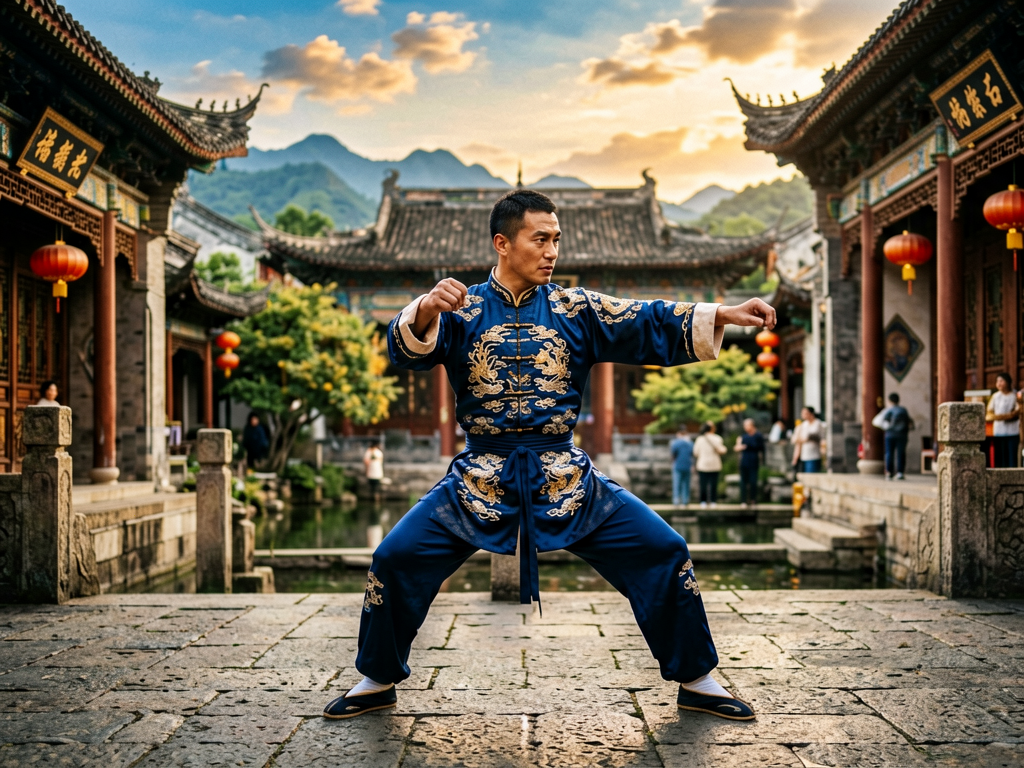
Discover the truth about Wing Chun. From Ip Man to real sparring, I break down what beginners need to know before hitting the mats.
CONTENT:
I still remember the smell of that small studio in Guangzhou. It wasn’t some polished, high-end gym with mirrored walls and air conditioning blasting at freezing temperatures. It was a converted room in an old residential building. The floor was sticky concrete, and the air smelled faintly of old sweat and liniment oil. But when I stepped inside, I felt something I haven’t felt in a long time. I felt completely useless. And it was glorious.
I had always thought of martial arts as this cool, cinematic thing. You know, the kind where guys jump ten feet in the air and kick through solid wood. Then I started Wing Chun. It’s nothing like the movies. It’s quieter. It’s closer. And honestly, it’s way more confusing than I ever expected.
If you’ve ever watched a Jackie Chan movie or seen a clip of Ip Man slapping people in the face, you probably have a specific image of what this martial art is. But the reality on the ground is different. It’s less about looking cool and more about physics, reflexes, and not getting hit.
Here’s the thing about Wing Chun. It’s not just a fighting style. It’s a cultural artifact that has survived empires, wars, and modernization. It’s pragmatic, efficient, and surprisingly gentle for something so deadly. If you’re thinking about trying it out, or if you’re just curious about why this specific branch of Kung Fu is so famous, stick with me. I’ve spent the last six months sweating through my shirts, and I’ve got some stories to tell.
Why Wing Chun Feels So Weird at First
Most people come to martial arts expecting to learn how to punch harder. You join a boxing gym or a Muay Thai class, and the goal is pretty straightforward: hit things, don’t get hit. You build muscle. You learn to take a hit. You look tough.
Wing Chun flips that script entirely. At first, it feels like you’re learning how to do the opposite of everything you know. You’re told to relax. You’re told to be soft. You’re told that if you tense up, you’re already losing. I’ll be honest, my first week was a disaster. My shoulders were tight as drumheads. I was stiff. I was trying to “muscle” the movements, and my instructor, Master Li, kept tapping my arm until it went numb.
He’d say, “Too much tension. You block with your mind, not your arm.” It sounded like nonsense to me. How do you block a punch without using your arm?
The core idea is structure. Wing Chun relies on skeletal alignment rather than muscular strength. Think of a tree. The roots don’t flex; they hold. The trunk doesn’t swing wildly; it absorbs. In our first lesson, we practiced the “Yee Jee Kim Yeung” stance. It looks simple, just standing with your knees slightly bent and your feet parallel. But hold it for ten minutes, and your legs will shake like jelly. That’s where the training starts. Not with punching, but with building a base that doesn’t collapse.
I remember asking Master Li if I had to do this stance forever. He laughed, a dry, raspy sound. He said, “You do it until your bones remember it. Then you don’t have to think about it.” That’s the goal here. Efficiency. When an attack comes, you don’t decide to block. Your body just reacts, using the shortest path to the threat.
It’s frustrating because it requires you to unlearn years of instinct. Your instinct says, “Raise your hands high and cross them!” Wing Chun says, “Keep your hands low and central. Protect your centerline.” Breaking that habit takes time. A lot of time. But once it clicks? It’s like flipping a switch. You start seeing angles you never noticed before.
The Centerline Theory: Protecting Your Boss
There’s a concept in Wing Chun called the “centerline.” Imagine a vertical line running straight down the middle of your body, from your nose to your navel. This is the boss. It’s the most vulnerable part of you. If someone gets their fist past your guard and touches this line, you’re in trouble.
Everything in Wing Chun revolves around this line. You try to stay on it. You try to attack on it. And you try to prevent your opponent from getting there. It’s not just about boxing; it’s about geometry. If you step to the side, you’re off the line. If you punch straight down the middle, you’re on it.
I learned this the hard way during a partner drill. My sparring partner, a guy named Wei who is tiny but moves like a ghost, kept slipping past my wide, swinging punches. I was flailing. I was trying to be dramatic. I was trying to look like I was in a movie. Wei just kept walking straight through my chaos. He’d tap my chest, then my nose, then my ribs. I couldn’t even see his hands move.
“Stop swinging,” he told me, catching my wrist. “Walk straight. Don’t cross your arms. Cross your arms, and you expose your center. Walk straight, and you threaten his.” It sounds so basic. So obvious. But in a split second, when adrenaline is pumping, your brain goes to chaos. Training the centerline is about making the right choice the automatic choice.
We spent weeks just doing “Chi Sao,” or sticky hands. It’s a sensitivity drill where you and your partner keep arms touching, feeling for openings. It’s not a fight. It’s a conversation. You push, I pull. I push, you yield. It’s like dancing, but if the dance goes wrong, you get poked in the eye.
I hated it at first. I thought it was slow and boring. But after a month, something shifted. I started feeling Wei’s intention before he moved. I could sense the weight shift in his shoulder. I could feel the tension in his elbow. It wasn’t magic. It was just heightened awareness. You start noticing how everyone moves. You notice how your friend leans when they’re nervous. You notice how the barista shifts her weight when she’s rushing.
Wing Chun makes you hyper-aware of your surroundings. It’s not just about fighting. It’s about being present. In a world where we’re all glued to our phones, that kind of presence is rare. And it’s powerful.
Myth-Busting: What Wing Chun Can (and Can’t) Do
Let’s address the elephant in the room. Wing Chun has a reputation. Some people think it’s the ultimate fighting style. Others think it’s useless against real violence. The truth, as always, is somewhere in the middle.
I’m no expert. I’m a beginner. But after months of training, I can tell you this: Wing Chun is excellent for self-defense in close quarters. If someone grabs your wrist, Wing Chun has specific counters for that. If someone punches you in a confined space, like a crowded subway car, you can’t swing your arms wide. Wing Chun is designed for tight spaces. It’s compact. It’s direct.
But it’s not a magic bullet. It won’t save you if you’re facing a trained boxer with reach. It won’t help you if you’re facing multiple attackers. No single martial art can guarantee safety in every scenario. Reality is messy. Fights are ugly. And Wing Chun, like any art, is only as good as the person practicing it.
I’ve seen people claim Wing Chun is the best because of the legendary Ip Man. And yes, Ip Man was amazing. But he was also a product of his time. He trained in a different era. Today’s fighters are smarter, faster, and more athletic. If you want to be a good fighter, you need to cross-train. You need to understand grappling. You need to understand striking from other styles.
Wing Chun is a great foundation. It teaches you structure, sensitivity, and directness. But it’s not the whole picture. Don’t buy into the hype that it’s the “secret weapon” of the universe. Treat it like any other skill. It takes work. It takes humility. And it takes a willingness to look foolish in front of others.
I’ve had friends tell me I’m wasting my time. They say, “Just learn boxing. It’s more practical.” And maybe they’re right. But there’s something about Wing Chun that resonates with me. It’s not just about hitting. It’s about flow. It’s about yielding. It’s about using an opponent’s energy against them. That philosophy appeals to me on a deeper level. It’s not just a fight technique; it’s a life lesson.
What to Expect When You Walk In
If you’re in China and want to try Wing Chun, you’ll find classes everywhere. In Guangzhou, it’s practically in the water. In Beijing or Shanghai, you’ll have to search for a reputable studio. Look for schools that emphasize “Chi Sao” and practical application. Avoid places that promise black belts in three months. That’s a scam.
Expect to pay between 200 and 500 RMB per month for regular classes. It’s affordable, but not cheap. Your uniform will be simple. A white cotton top and black pants. No colored belts, no fancy gear. Just you and your instructor.
You’ll spend a lot of time standing still. You’ll do forms (Kata) that look slow and graceful. You’ll do drills that look repetitive and boring. You’ll get hit. A lot. Not hard, but enough to remind you that you’re vulnerable.
But then, there are those moments. You’re sparring, and your opponent goes for a punch. You don’t think. You just move. Your hand deflects, you step in, and you tap their chest. It’s clean. It’s efficient. It feels right. In that split second, you feel connected to centuries of practitioners who did the exact same thing. You feel part of a lineage. You feel alive.
That’s the hook. It’s not about the technique. It’s about the feeling. It’s about mastering yourself. And honestly, in a chaotic world, that’s worth more than any fight won.
So, if you’re curious, go try it. Find a local gym. Introduce yourself. Show up. Sweat. Fail. Repeat. You might not become a master. You might not ever fight again. But you’ll learn how to stand your ground. And you’ll learn how to flow when things get tough. That’s a skill you can use anywhere, anytime. Trust me, it’s worth the sticky floor.