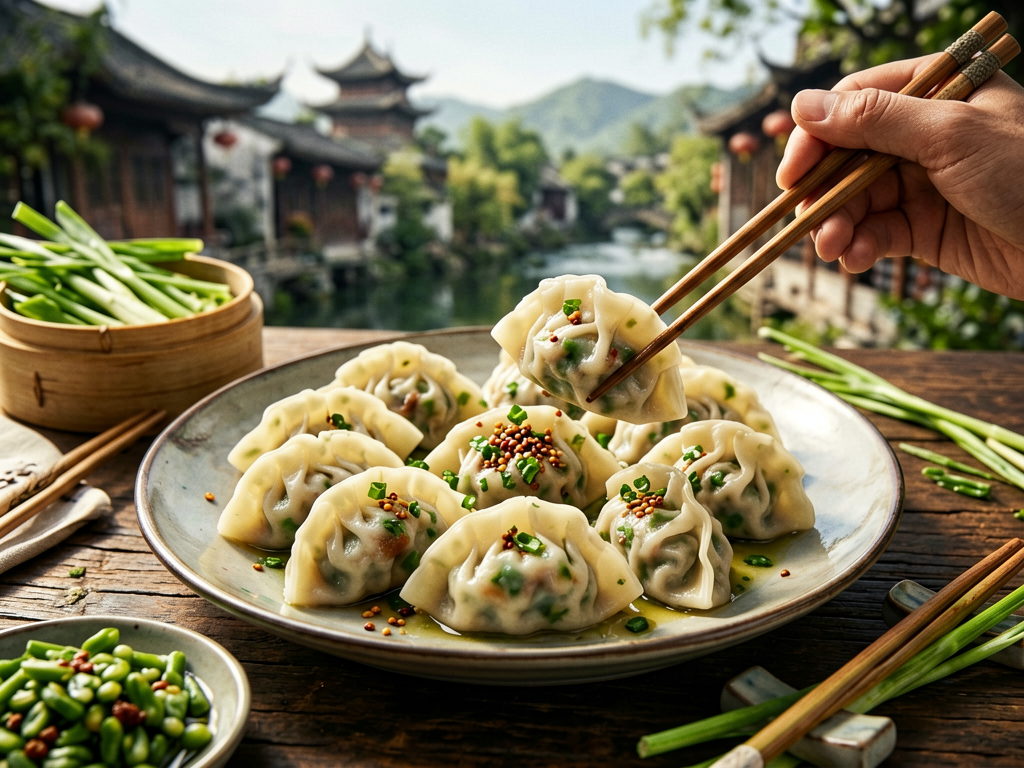
Look, I’ve been eating dumplings in China for eight years. I’ve eaten them on street corners in Xi’an, in cramped family kitchens in Chengdu, and in fancy hotels in Shanghai. And I’m here to tell you that if you think “dumpling” is just a small pocket of meat and cabbage wrapped in dough, you’re missing out on one of the most complex, delicious, and culturally rich food stories on the planet.
Here’s the thing about Chinese dumplings. They aren’t a single dish. They’re a family. A massive, chaotic, delicious family where every member has a distinct personality, a different shape, and a completely different way of being cooked.
When you walk into a restaurant in Beijing, you order *jiaozi*. When you’re in Shanghai, you order *xiaolongbao*. In Sichuan, it’s *jiaozi* again, but they look nothing like the Beijing version. In Guangdong, you might get *har gow*. And in Xinjiang, you’re looking at *manti*.
Surprised? Good. Because that’s exactly how it should be. China is huge. It’s got diverse climates, different agricultural histories, and distinct cultural influences. So naturally, every region decided to put its own spin on the concept of “stuffing wrapped in dough.”
The Northern Heavyweights: Jiaozi and Wontons
Let’s start where it all feels most traditional for many outsiders: the North. Specifically, Beijing and the surrounding provinces. Here, the dumpling isn’t just food; it’s a religion. Or at least, it’s a mandatory part of any major holiday.
I remember my first winter in Beijing. It was January, and the wind was cutting through my coat like a knife. My host family invited me over for New Year’s Eve. The living room was filled with flour. Everyone was sitting around a low table, rolling dough and filling wrappers.
The dumplings here are called *jiaozi*. They’re thick-skinned, usually boiled, and shaped like ancient gold ingots. That’s not just for aesthetics. In Chinese culture, the shape symbolizes wealth. Eating them is a way to invite prosperity into your new year.
The filling is hearty. You’re looking at pork and Chinese cabbage, maybe some chives or ginger. It’s savory, salty, and comforting. You dip it in black vinegar and maybe a little chili oil. It’s simple, but it’s profound in its simplicity.
But wait, don’t forget the fried version. Pan-fried *jiaozi* are a snack staple. The bottom gets crispy and golden, while the top remains soft. It’s the perfect textural contrast. I’ve probably eaten fifty of these in my time in Beijing alone. They’re addictive.
The Shanghai Soup Bombs: Xiaolongbao
Now, let’s head south to Shanghai. If Northern dumplings are about substance, Shanghai’s *xiaolongbao* are about engineering. These are the famous soup dumplings that tourists line up for hours to eat.
I’ll be honest, I was skeptical at first. How do you get soup inside a steamed bun without it leaking? It seemed impossible. But then I tried my first one in a small alleyway restaurant in the French Concession.
The secret is in the aspic. The broth is turned into a solid jelly before being mixed with the pork filling. When the dumpling steams, that jelly melts back into liquid soup. It’s culinary magic.
Eating them is a performance. You don’t just bite into it. You take a tiny bite at the top, suck out the hot broth, and then eat the rest. If you’re not careful, you’ll burn your tongue. I know I did. A lot.
The skin is incredibly thin, almost translucent. You can see the pink pork inside. It’s delicate. It requires patience. And when you get it right, the combination of the savory pork, the rich broth, and the slight sweetness of the skin is unmatched.
It’s expensive, too. These aren’t street snacks. They’re a sit-down experience. But trust me, it’s worth the wait. It’s a lesson in precision.
Sichuan’s Spicy Twist: Hong You Jiaozi
If you think Sichuan food is just spicy, you haven’t tried their dumplings. In Chengdu, the *jiaozi* are different from Beijing’s. They’re smaller, the wrappers are thinner, and the filling often includes shrimp or beef.
But the real star is the sauce. Sichuan dumplings are served dry, with a massive amount of chili oil, garlic, and sesame paste. It’s called *Hong You Jiaozi*.
I remember walking into a small eatery in Chengdu after a long day of hiking in the mountains. I was hungry and cold. I ordered this dish. The bowl arrived, red and glistening. It looked intimidating.
The first bite was an explosion. The heat hit you immediately, but it was a clean, aromatic heat. The garlic cut through the spice, and the sesame paste added a creamy nuttiness. It was complex.
Unlike the boiled dumplings in the north, these are often steamed or boiled and then tossed in the sauce. The texture is softer. The flavor profile is aggressive. It’s not for the faint of heart.
It’s a great example of how regional ingredients change the dish. Sichuan peppercorns might be added to the sauce, giving it that signature numbing sensation. It’s a totally different experience from the vinegar-dipped dumplings of the north.
Guangdong’s Delicacy: Har Gow and Siu Mai
Let’s go even further south to Guangdong, specifically Canton. Here, dumplings are part of *Dim Sum*. And the dumplings are art.
Take *har gow*, the shrimp dumpling. The wrapper is made from wheat starch, not regular flour. This makes it translucent and slightly chewy. It’s a completely different dough texture than anything you’ve had in the north.
The shrimp is whole, or at least a large piece of it. You can see the pink tail sticking out. It’s sweet, delicate, and light. It’s steamed, not fried or boiled.
Then there’s *siu mai*. These are open-topped dumplings. You see the pork and shrimp filling peeking out from the top. They’re often topped with a little roe for color and flavor.
Eating dim sum is a social event. It’s slow. It’s leisurely. You order small plates, share them, and talk for hours. The dumplings are just one part of the experience, but they’re the centerpiece.
It’s less about the heaviness of the meal and more about the variety. You might have three types of dumplings, some rice rolls, and some buns. It’s a sampler platter of culinary excellence.
The Western Frontier: Manti and Laghman
We can’t talk about Chinese dumplings without mentioning the Northwest. In Xinjiang, the influence of Central Asia and the Turkic peoples is strong. The dumplings here are called *manti*.
These are large, square dumplings. They’re steamed and then often served with yogurt or a spicy tomato sauce. The filling is usually lamb and onion. It’s gamey, rich, and deeply flavorful.
I tried these in Urumqi, the capital of Xinjiang. The lamb was tender, melting in my mouth. The yogurt sauce cooled down the spice. It was a perfect balance.
The dough is thicker here, designed to hold up to the heavier fillings. It’s a rustic style of dumpling. It’s not delicate like the Shanghai version. It’s hearty and robust.
It’s a reminder that China’s food culture is a mosaic. The dumpling concept traveled along the Silk Road and adapted to local tastes. In Xinjiang, that meant lamb, yogurt, and larger sizes.
Why This Matters
So why does this matter? Why should you care that there are different types of dumplings?
Because it’s a window into the culture. The shape, the filling, the cooking method–it all tells you about the region. The north is cold, so they eat heavy, wheat-based foods. The south is warm, so they eat lighter, rice-based, or delicate steamed items. The west is arid and influences from other cultures are strong.
Eating these dumplings is like traveling through China without leaving your plate. It’s an edible map of the country’s diversity.
I love this about Chinese food. It’s not monolithic. It’s not just “Chinese food.” It’s thousands of local variations, each with its own history and pride.
Next time you’re in China, don’t just order “dumplings.” Ask what they recommend locally. Try the soup dumplings in Shanghai. Try the spicy ones in Sichuan. Try the steamed ones in Guangdong.
You’ll be surprised by how much you miss if you stick to just one. And honestly, you’ll probably start craving the next one before you finish the current one. That’s just how good they are.
So, are you ready to expand your dumpling horizons? I hope so. Because once you start, you won’t want to stop.