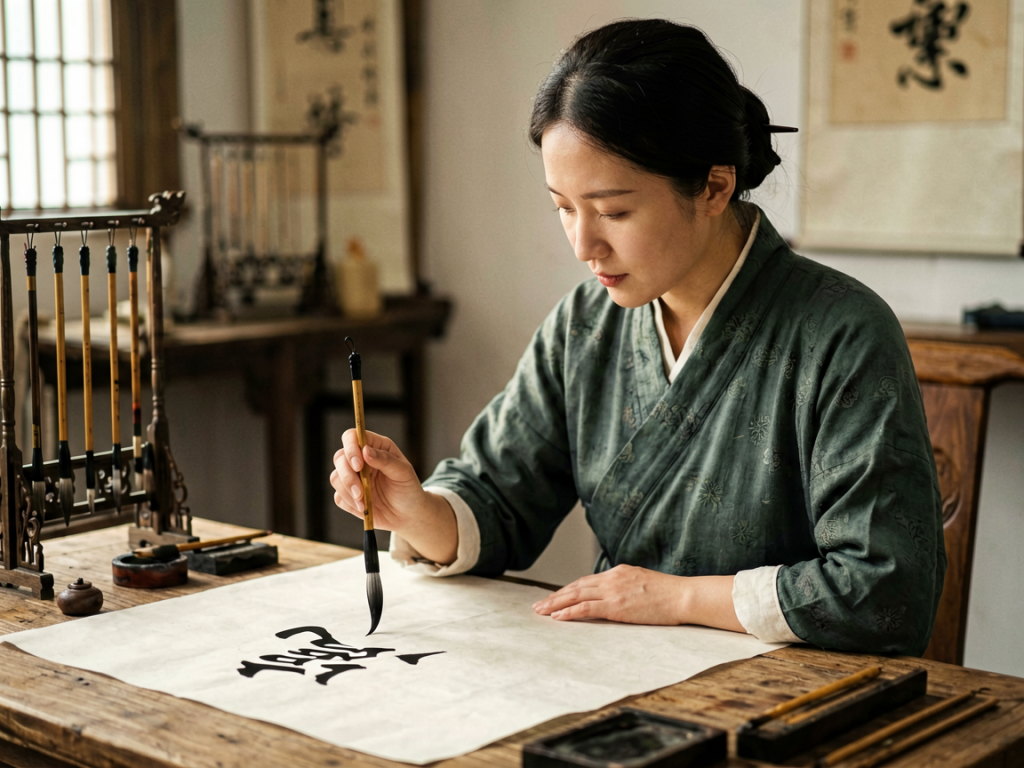
Chinese Calligraphy: More Than Just Writing
Chinese calligraphy (书法, shūfǎ) is the highest form of visual art in Chinese culture. It’s not about writing words — it’s about expressing the writer’s character, emotion, and energy through brushstrokes. A skilled calligrapher’s work reveals their personality to anyone who can read the art.
The tools are called the Four Treasures of the Study (文房四宝): brush, ink, paper, and inkstone. The brush is typically made from animal hair (wolf, goat, or weasel). The ink is a solid stick ground with water on an inkstone. The paper is xuanzhi (宣纸) — a soft, absorbent rice paper that responds to the lightest touch.
There are five major scripts: seal script (篆书, zhuan shu) — the oldest, used for seals and stamps; clerical script (隶书, li shu) — angular and formal; regular script (楷书, kai shu) — the standard, most legible script; running script (行书, xing shu) — semi-cursive, faster; and cursive script (草书, cao shu) — wild, expressive, almost impossible for beginners to read.